In this articleSections · 17
Executive summary
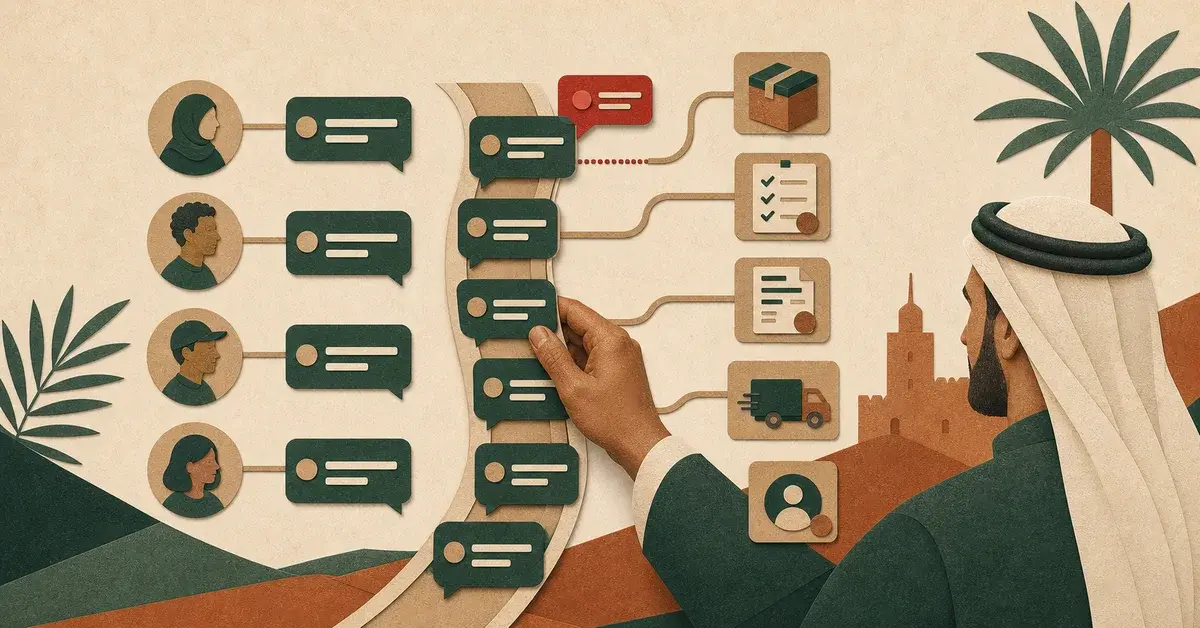
For many Saudi businesses, WhatsApp is already the operating system: leads arrive there, customers follow up there, approvals happen there, and support lives there. AI automation works best when it respects that channel instead of forcing teams into another dashboard.
For many Saudi businesses, WhatsApp is not a messaging app. It is the real business operating system.
Leads arrive there. Customers ask questions there. Owners approve things there. Teams chase missing information there. Suppliers send updates there. Clinics confirm appointments there. Agencies coordinate assets there. Families, founders, employees, and customers all already know how to use it.
So when an AI automation strategy ignores WhatsApp, it ignores where the work actually happens.
The dashboard is not always the center
A lot of software assumes the dashboard is the center of work. In Saudi SMEs, that is often false.
The dashboard may hold records, but the motion of the business happens in conversations:
- A customer asks for a price.
- A lead sends a voice note.
- A manager approves a discount.
- A clinic confirms a follow-up.
- A supplier shares a delivery update.
- A founder asks, "وين وصلنا؟"
The system of record and the system of action are not always the same. WhatsApp is often the system of action.
Why WhatsApp wins operationally
WhatsApp wins because it has almost no adoption barrier.
No new login. No training. No dashboard habit. No explanation. People already check it all day.
That makes it powerful for operational automation:
- Lead capture.
- Follow-up reminders.
- Support triage.
- Internal approvals.
- Customer updates.
- Appointment reminders.
- Missing-information requests.
- Daily summaries.
The point is not to keep everything inside WhatsApp forever. The point is to meet the workflow where it already lives.
The problem: WhatsApp does not scale cleanly
WhatsApp is convenient, but unmanaged WhatsApp becomes chaos.
Common problems:
- Leads get buried.
- No one knows who replied.
- Voice notes hide important details.
- Customer context sits in one person's phone.
- Follow-ups depend on memory.
- Managers ask for updates manually.
- Reporting becomes copy-paste work.
- Support quality varies by person.
This is where AI automation can help, but only if it respects the channel.
What a WhatsApp AI layer should do
A useful AI layer around WhatsApp should not pretend every conversation is a chatbot session.
It should help with the real operations around the conversation:
Capture
Extract the important details:
- Name.
- Phone.
- Request type.
- Product or service interest.
- Deadline.
- Missing information.
- Urgency.
- Owner.
Summarize
Turn long chats and voice-note transcripts into a short operational brief.
Route
Send the request to the right person or queue.
Draft
Prepare a reply in the right Arabic/English tone, but keep human review visible.
Follow up
Remind the team when a lead, customer, or internal approval is stuck.
Report
Create a daily or weekly summary without making a manager open another dashboard.
WhatsApp for lead generation
For Saudi SMEs, the lead form is often not the real lead form. WhatsApp is.
A customer may click an ad, ask for price, send a screenshot, request location, or say "عندكم هذا؟" The business needs to turn that into structured sales motion.
A good WhatsApp lead system should:
- Classify the lead.
- Capture source and intent.
- Ask for missing details politely.
- Draft the first response.
- Create a CRM record when useful.
- Remind the owner if no one follows up.
- Measure time-to-first-response.
The key metric is not how many messages arrived. It is how many qualified conversations turned into next steps.
WhatsApp for support
Support over WhatsApp needs speed and consistency.
AI can help by:
- Detecting common issue types.
- Suggesting replies from approved policies.
- Flagging angry or urgent messages.
- Summarizing previous context.
- Routing refunds, complaints, and technical issues.
- Drafting Arabic replies that sound natural.
But support automation should be careful. A customer who is upset does not want a robotic answer. The AI should help the human respond faster and better, not remove judgment from sensitive moments.
WhatsApp for internal operations
Some of the highest ROI is internal.
Examples:
- Daily project updates collected from team chats.
- Approval requests summarized for the founder.
- Procurement offers compared from shared messages.
- Missing documents flagged before a deadline.
- Weekly team summaries prepared automatically.
- Repeated questions answered from internal knowledge.
This is where WhatsApp becomes a lightweight operating layer. The team keeps its habit, while the business gets structure.
The trust rules
A WhatsApp AI system needs clear boundaries:
- Do not send externally without approval unless the rule is explicit.
- Label AI-drafted messages internally.
- Keep customer data handling clear.
- Log what was sent and by whom.
- Escalate sensitive cases to humans.
- Respect Arabic tone and relationship context.
These rules are not bureaucracy. They are what make the system usable.
The founder checklist
Before building WhatsApp automation, ask:
- Which conversations create money, risk, or delay?
- What details must be captured every time?
- Who owns each request type?
- What can AI draft safely?
- What must stay human-approved?
- Where should structured records live after the chat?
- What is the response-time target?
- What daily summary would save the founder time?
If the answers are clear, automation becomes straightforward.
The future is not just chatbots
The lazy version of WhatsApp AI is a bot that answers everything.
The better version is an operations layer:
- It listens.
- It structures.
- It drafts.
- It routes.
- It reminds.
- It reports.
- It escalates.
That is much more valuable than a generic bot.
Saudi businesses already run on WhatsApp. The opportunity is not to replace that habit. The opportunity is to make the habit operationally clean.