In this articleSections · 10
Executive summary
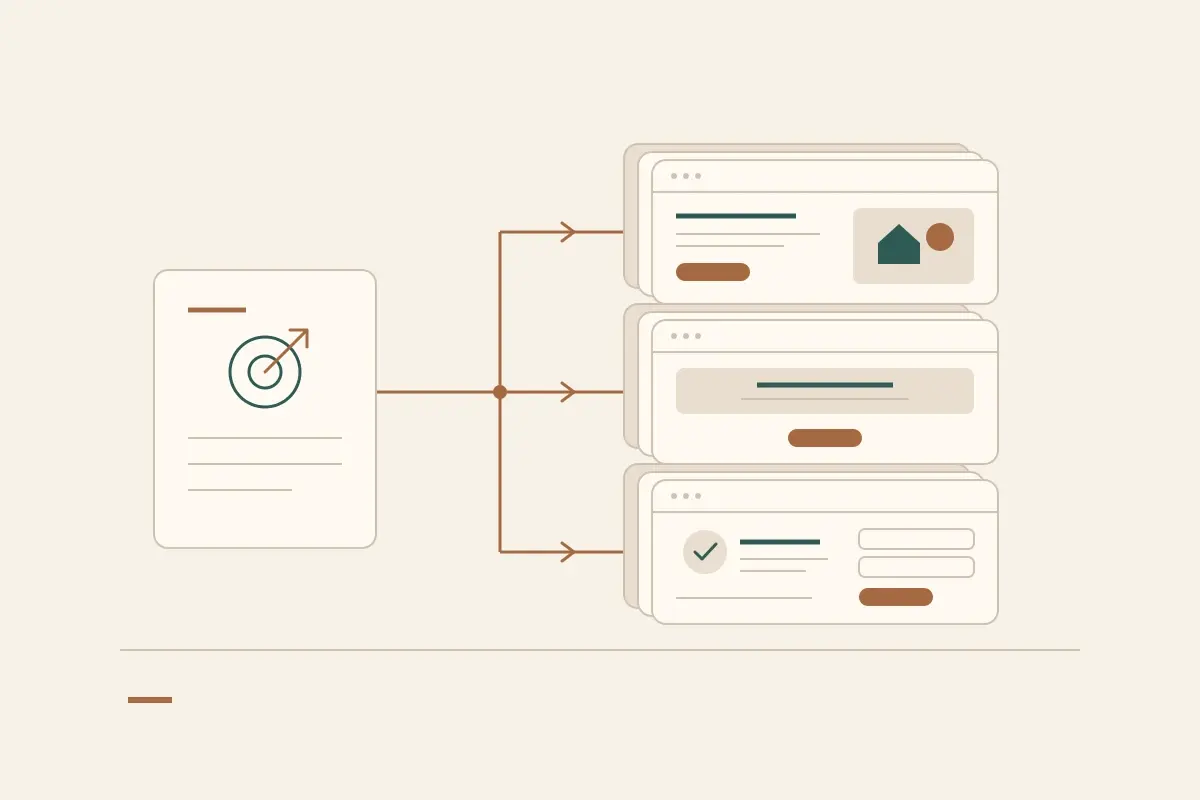
As a digital marketer, I see landing pages becoming a larger part of campaign strategy. My forecast is that a sufficiently large campaign could support up to 100 purposeful page variants. The opportunity comes from matching intent, language, proof, and offer, with shared design, human review, and measurement through to qualified leads and sales.
Arabic summary
بصفتي مسوق رقمي، أشوف إن صفحات الهبوط بتاخذ دور أكبر في الحملات. أتوقع إن الحملة الكبيرة ممكن توصل إلى 100 نسخة تخدم احتياجات مختلفة، بشرط وضوح الرسالة، ومراجعة المحتوى، وقياس جودة العملاء والمبيعات.
As a digital marketer, I have recently started seeing a trend take shape: the landing page is becoming a much bigger part of the campaign itself. We spend enormous effort getting the right person to click. The next opportunity is to give that person a destination that understands why they clicked.
My forecast is that, in the future, a single campaign could have up to 100 landing pages or deliberately managed page variants. For campaigns with enough audience diversity, traffic, and operational capacity, that could become a normal way to work. It is my view of the direction of travel, rather than an established industry benchmark or a target every business should adopt.
Landing pages have been around for decades. What feels newly powerful is the possibility of making them specific enough, affordable enough to maintain, and measurable enough to become a serious marketing advantage.
Landing page vs. homepage: the opportunity after the click
A landing page is the destination a visitor reaches after clicking an ad, email, search result, or campaign link. A dedicated campaign page has a focused job: help that visitor understand an offer and take a relevant next step.
A homepage introduces the wider business and helps different visitors explore. A campaign landing page narrows the explanation around one audience, one promise, and one primary action. That is the starting point for a useful landing page strategy.
Consider an illustrative campaign for a business software subscription. An operations manager clicks an ad about reducing manual follow-up. A finance manager clicks an ad about understanding cost. A founder clicks an ad about launching quickly. Send all three to the same general homepage and each has to reconstruct the promise that caught their attention.
A focused page can continue the conversation. The operations version explains the workflow and shows a credible example. The finance version explains pricing and what is included. The founder version explains setup, dependencies, and the next decision. The product remains the same; the order of explanation changes to meet a different question.
That continuity is often called message match: the ad's promise, the page's headline, the supporting evidence, and the call to action belong to the same conversation. It does not require knowing everything about a visitor. The campaign link and the intent it represents may be enough.
Google explicitly includes landing-page relevance and usefulness among the components of Quality Score. It also says Quality Score is a diagnostic tool, not an input into the ad auction. The useful lesson is to investigate whether the destination helps the visitor, rather than chase the score as a business outcome. Google Ads: About Quality Score.
Why I see this trend accelerating
Three developments make a larger landing-page portfolio more plausible.
First, shared components let a team reuse a dependable structure while changing the argument, evidence, and next action. One improvement to the form, accessibility, or layout can benefit many pages. Maintaining a campaign becomes more manageable when the pages share foundations.
Second, AI can help draft alternatives, organize customer questions, and adapt approved copy into initial versions. A marketer still has to decide whether the segment matters, whether the claim is true, and whether the language sounds like the brand. The practical opportunity is faster preparation with accountable review. I explored the same production challenge in building an AI content engine without losing taste.
Third, ad platforms are making destination selection more sensitive to intent. Google's AI Max documentation describes final URL expansion, which can select a more relevant landing page based on a search query. That is evidence that matching intent to a destination matters within the product's design; it does not establish that every advertiser needs 100 pages or guarantee a conversion improvement. Google Ads: About AI Max for Search campaigns.
My inference is that, as creating and routing variations becomes easier, the marketer's most valuable work moves toward deciding which differences deserve a page and whether those differences improve the customer journey.
There is a regional example too. Zid's help center describes dedicated pages for individual products, with page-level visits, orders, sales, and conversion reporting. That gives Saudi ecommerce teams a practical way to connect a focused offer with measurable outcomes; the feature itself does not prove a performance gain. Zid: Landing pages.
What the evidence actually tells us
Unbounce's 2024 Conversion Benchmark Report reports a median landing-page conversion rate of 6.6% across its analyzed sample. The report draws on more than 41,000 landing pages, 464 million visitors, and 57 million conversions. Unbounce: Conversion Benchmark Report.
That is useful context, with important limits. The data covers July 23, 2023 through July 23, 2024 and comes from a landing-page vendor's customer sample. Its methodology excludes pages with fewer than 50 visitors and pages with no conversions. A conversion also need not be a sale. The figure is neither a universal target nor proof that adding pages causes better results. Unbounce: Report methodology.
For my own decision-making, I would compare pages serving similar intent, traffic sources, and conversion goals. A newsletter signup and a qualified request for an enterprise proposal represent very different levels of commitment. Reporting both as “a conversion” does not make them equally valuable.
How one campaign could reach 100 landing pages
Here is a planning example, not a client result or a deployment recommendation. Imagine a regional software campaign with five meaningful customer segments, five buying questions, two languages, and two legitimate offers.
| Planning dimension | Example | Variants |
|---|---|---|
| Customer segment | Retail, ecommerce, agencies, professional services, logistics | 5 |
| Buying question | Suitability, use case, integrations, migration, pricing | 5 |
| Language | Arabic and English | 2 |
| Offer | Guided demo or trial, where both are available | 2 |
5 × 5 × 2 × 2 = 100 possible page variants.
The multiplication describes the available design space. Some combinations will not deserve their own page. A customer with a migration question may need a guided demo, while a trial makes sense for someone ready to explore independently. Build the combinations that represent a real need and a valid offer.
Those experiences could use separate URLs or controlled versions of shared templates. The important requirement is that each variation has a stable identifier, a clear reason to exist, approved content, and measurable outcomes. A portfolio of 100 pages can share a handful of layouts and one design system. It does not require 100 separately maintained websites.
A small campaign might justify three to five pages. A larger campaign could gradually expand toward 100 as the audience, evidence, and economics support it. The forecast is about the capacity to serve more distinct intentions; page count alone tells us little about quality.
Landing page optimization: what should change between pages?
Changing a city name in the headline rarely answers a different customer question. Useful variation changes the information that helps someone decide.
| Page element | A meaningful change |
|---|---|
| Opening promise | The specific problem introduced by the ad |
| Demonstration | A workflow or product example relevant to that segment |
| Evidence | A relevant, permissioned testimonial or documented case |
| Objections | Pricing, migration, integrations, or implementation questions |
| Next action | A demo, quote request, purchase, or trial that fits readiness |
| Language | Natural local copy, readable layout, and a consistent offer |
The underlying truth must stay consistent. Pricing, availability, limitations, and product capabilities need an approved source that all variations follow. AI can help rewrite an explanation; it cannot invent a customer result, testimonial, local office, or feature to fill a template.
I would also keep necessary trust information easy to find: who operates the business, how to make contact, what happens after submitting, and the relevant terms and privacy information. Focus should make the decision easier without hiding information the customer needs.
Arabic and English deserve deliberate experiences
For Saudi and GCC campaigns, translation is only part of the work. A page needs to carry the same offer and level of credibility in both languages, while sounding natural in each.
On the Arabic version, I would review the headline in its own right, use readable Arabic typography, check right-to-left layout, and test mixed content such as prices, product names, email addresses, and phone numbers. On mobile, the form and primary action need to stay comfortable to read and use.
If the action starts a WhatsApp conversation, a click measures an attempt to open the channel. A qualified conversation or sale needs a separate signal. If the action requests a call, the confirmation should explain what happens next without implying an appointment has already been booked.
These details connect directly to the question I discuss in Arabic UX for local AI products: does the experience feel built for the person using it?
The limit is learning capacity
The easiest mistake is to publish more variants than the campaign can learn from. Suppose, for illustration, a campaign receives 10,000 eligible visits in a month. Split them evenly among 100 pages and each receives 100 visits. If the underlying conversion rate were 5%, that would mean only five expected conversions per page, with substantial variation around that expectation. It would be a weak basis for ranking 100 winners and losers.
Actual sample requirements depend on the baseline, the smallest improvement worth detecting, the measurement, and the statistical method. Microsoft's experimentation guidance emphasizes statistical power and planning before an experiment begins. Microsoft Research: Trustworthy experimentation, pre-experiment stage.
My approach would be to route each audience to a relevant experience, then test a limited number of alternatives within comparable audiences. A higher conversion rate on the pricing page may reflect stronger visitor intent, rather than better design. Where possible, random assignment within the same segment helps separate those explanations.
Before a test starts, define the primary metric, the observation window, the sample requirement, and the rule for stopping or choosing a version. Repeatedly checking many variants and declaring the current leader a winner creates misleading confidence. When traffic is limited, consolidate pages and prioritize the most consequential questions.
Measure through to the business outcome
My measurement chain would be: campaign visit, successful submission or purchase, qualified lead where relevant, and downstream sale. Each stage answers a different question.
For a lead-generation campaign, I would calculate cost per qualified lead as campaign spend divided by qualified leads. I would also track qualification rate, sales conversion, and the time it takes to respond. For ecommerce, purchase conversion, acquisition cost, returns, and contribution margin can reveal whether an attractive page is attracting profitable orders.
A hypothetical example shows why this matters. At the same spend of SAR 10,000, one experience generates 100 leads and 20 qualify: SAR 500 per qualified lead. Another generates 70 leads and 28 qualify: about SAR 357 per qualified lead. The second produces fewer forms but a better result on that particular measure. These are illustrative numbers, not reported campaign results; sales outcomes could still change the decision.
Keep campaign and variant identifiers attached to the measurement flow, verify that a submission actually reaches the intended system, and avoid placing personal information in tracking URLs. A page with beautiful copy and broken lead delivery cannot support a useful experiment.
Scale the operating process with the pages
A large page portfolio needs an owner and a retirement policy. I would maintain a simple register for each variant: audience, intent, offer, language, source campaign, approved proof, owner, test status, last review date, and destination URL.
Shared components should carry improvements to forms and accessibility across the portfolio. Shared approved content should keep prices and product facts aligned. Review should catch expired offers, broken links, mismatched ad promises, unsupported claims, and pages that no longer receive useful traffic.
Paid campaign variants also need a deliberate search strategy. Google's spam policies describe doorway abuse and scaled content created primarily to manipulate search rankings. A hundred near-identical pages aimed at capturing search queries is a different proposition from purposeful campaign experiences. Decide which pages have standalone search value and review indexing and canonicalization accordingly. Google Search Central: Spam policies.
A practical first-month plan
I would begin with one offer, one clear business objective, and a small set of meaningful differences.
- Week 1: map intent. Review the ads, customer questions, and current destination. Select three to five priority audience needs and record a baseline.
- Week 2: build and review. Create focused pages from shared components. Check both languages, mobile layout, keyboard access, claims, forms, and confirmation messages.
- Week 3: launch and observe. Route the intended traffic, verify measurement and lead delivery, and start only the comparisons the available traffic can support.
- Week 4: assess and decide. Review qualified outcomes and operational problems. Keep collecting data if the evidence is still weak; expand, revise, or retire pages when there is a defensible reason.
Four weeks is an operating rhythm, not a promise of statistical significance or a guaranteed lift.
My expectation remains that campaign planning will increasingly include a portfolio of destinations, potentially up to 100 for a sufficiently large campaign. The advantage will belong to marketers who can explain why each page exists, deliver its promise, and learn what happens after the click.
If you want to apply this to your business, tell me about your campaign and current landing page. I can help review the audience, message, and page structure, then define a manageable first set of experiences. For the content-production side, read my article on AI and cultural relevance in marketing; for reusable starting points, explore the prompt library.